Warning: Undefined variable $post in /home/quantdev/thechangelab.stanford.edu/wp-content/themes/lagunita-theme/Lagunita.php on line 124
Warning: Attempt to read property "ID" on null in /home/quantdev/thechangelab.stanford.edu/wp-content/themes/lagunita-theme/Lagunita.php on line 124
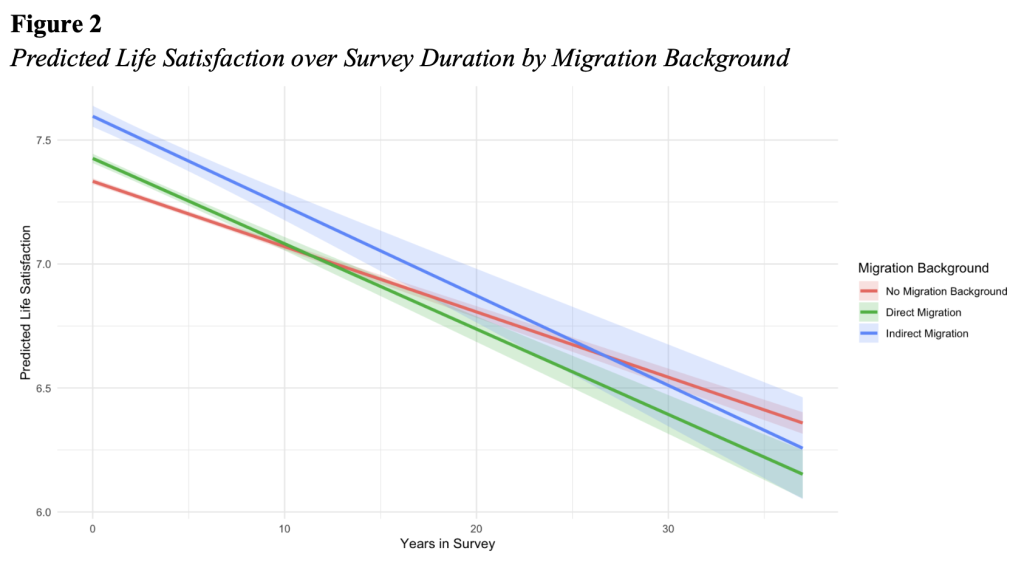
Figure 2. Predicted Life Satisfaction over Survey Duration by Migration Background. Note: Life satisfaction predictions were generated from the fitted linear mixed-effects model and applied to a constructed dataset spanning 0 to 37 years in the survey. Shaded areas represent 95% confidence intervals around the predicted values.
“But Where Are You Really From?” The Cost of Movement: A Longitudinal Analysis of Migrant Life Satisfaction and Health Outcomes in Germany
A growing body of research has documented the “healthy immigrant effect” (HIE), whereby immigrants initially exhibit better health outcomes than native-born populations but experience more rapid health decline over time. However, much of this research relies on cross-sectional data and focuses primarily on first-generation migrants, leaving questions about how health trajectories evolve across generations. Applying linear growth models to longitudinal data from the German Socio-Economic Panel (SOEP), I examine changes in life satisfaction, health satisfaction, and self-reported health limitations for N = 99,433 participants (Mage = 39, SD = 17; 50% female) over a 37-year period. The sample includes individuals with no migration background (n = 64,954), direct migration background (n = 29,016), and indirect migration background (n = 5,463).
I found that life satisfaction (p < .001) and health satisfaction (p < .001) declined significantly over time across the sample, while physical (p < .001) and emotional health limitations increased (p < .001). Individuals with migration backgrounds reported higher baseline life satisfaction and health satisfaction, but experienced steeper declines and greater decreases over time compared to non-migrants. Patterns of health limitations varied by migration background: direct migrants showed faster deterioration in physical health, while indirect migrants exhibited more moderate, and in some cases slower, decline. Emotional health trajectories also differed, with direct migrants reporting worse baseline emotional health but slower decline over time, and indirect migrants showing patterns more similar to non-migrants. These findings showing that disparities in migrant health emerge over time suggest cumulative impact of post-migration experiences on long-term health outcomes.


![Honors Posters at Symposium of Undergraduate Research and Public Service [April 25, 2026]](https://thechangelab.stanford.edu/wp-content/uploads/2026/04/Garg_SURPSVig_20260425-300x95.png "Honors Posters at Symposium of Undergraduate Research and Public Service [April 25, 2026]")