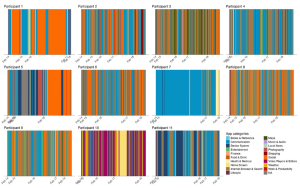
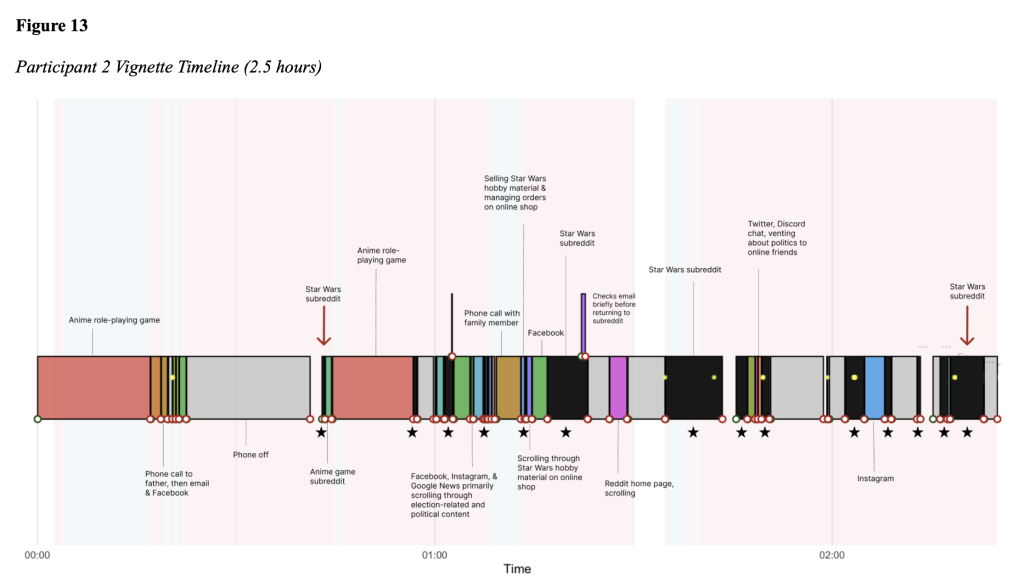
In the modern world, screens demand our attention constantly, whether for work, information, or entertainment. Endless streams of media are available at all hours of the day. Online and offline, people share anecdotes that their phone use has reduced their attention span and ability to focus. What is it about smartphones that is causing so many to feel this way? While researchers are studying the relationship between smartphone and media use and attention, existing studies are limited by reliance on cross-sectional surveys, self-reports, and experimental designs that fail to capture naturalistic, moment to-moment behavior or the qualitative nature of digital content. In this paper, I address these gaps using a mixed-methods approach using Screenome data from the Human Screenome Project (HSP; Reeves et al., 2020) to study smartphone use and attention, with a specific focus on how smartphone use is related to ADHD symptoms. I employ Bayesian multilevel modeling to examine longitudinal associations between individuals’ phone interaction dynamics and attention measures (n = 217; mean age = 44, 50% female, mean daily screentime = 4.84 hours), and qualitative analysis of high-frequency smartphone screenshots to examine fine-grained patterns of media consumption (n > 6 million). Results show that while between-person differences in phone interaction patterns, including higher burstiness (95% Bayesian Credible Interval [0.01, 0.41]), screentime (95% CI [0.37, 4.19]), and app-switching (95% CI [0.93, 1.02]), are associated with higher overall levels of ADHD symptoms, within-person changes in phone interaction patterns may not be related to within-person changes in ADHD symptoms. However, qualitative analysis of screenshot sequences for three participants provides informative narrative descriptions of the complex ways that digital behavior and screen content influence or reflect patterns of attentional flow on the scale of seconds, minutes, and hours.


![Honors Posters at Symposium of Undergraduate Research and Public Service [April 25, 2026]](https://thechangelab.stanford.edu/wp-content/uploads/2026/04/Garg_SURPSVig_20260425-300x95.png "Honors Posters at Symposium of Undergraduate Research and Public Service [April 25, 2026]")