Warning: Undefined variable $post in /home/quantdev/thechangelab.stanford.edu/wp-content/themes/lagunita-theme/Lagunita.php on line 124

Warning: Attempt to read property "ID" on null in /home/quantdev/thechangelab.stanford.edu/wp-content/themes/lagunita-theme/Lagunita.php on line 124
Bayesian Response Surface Analysis (BRSA) for Congruence Hypothesis

Bayesian Response Surface Analysis (BRSA) for Congruence Hypothesis

  1. |
  2. News & Updates
  3. |
  4. Conference
  5. |
  6. Bayesian Response Surface Analysis (BRSA) for Congruence Hypothesis

Zhenchao Hu

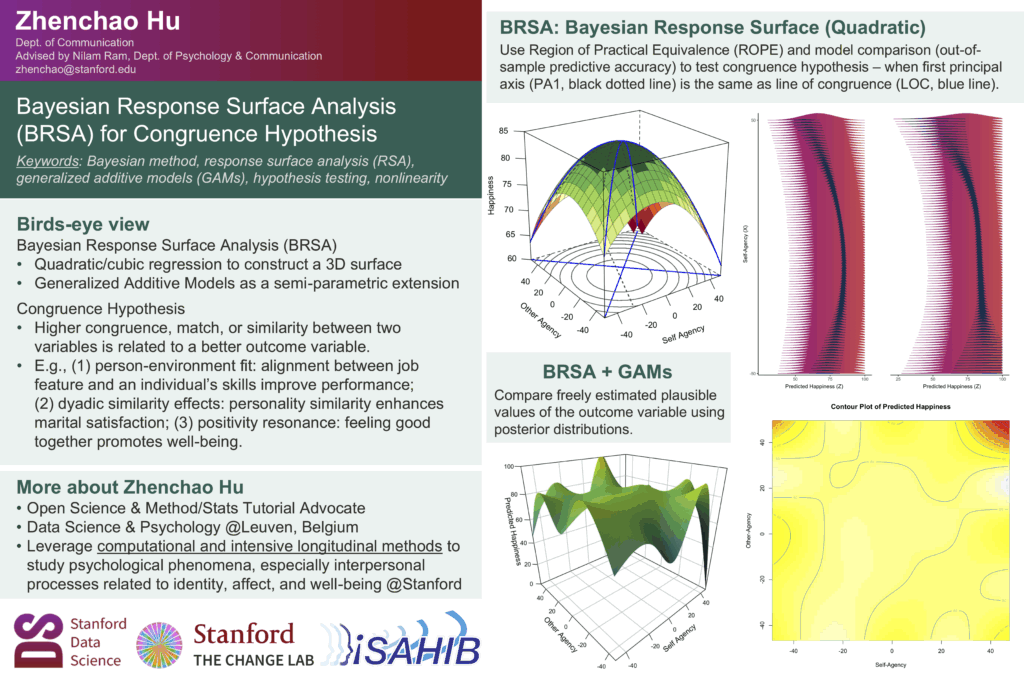
A large body of social scientific research has been interested in how two variables work together to predict one outcome. Example research questions range from personality psychology (person-environment fit studies whether alignment between job feature and an individual’s skills improve performance and individual well-being), clinical psychology (patient-therapist similarity and fit improves therapeutic success), media and communication studies (third-person effect investigates the difference between the perceived harm of media on others and on self influences the likelihood of endorsing digital detox), and interpersonal processes (behavioral, cognitive, emotional synchrony promotes cooperation and social connection).

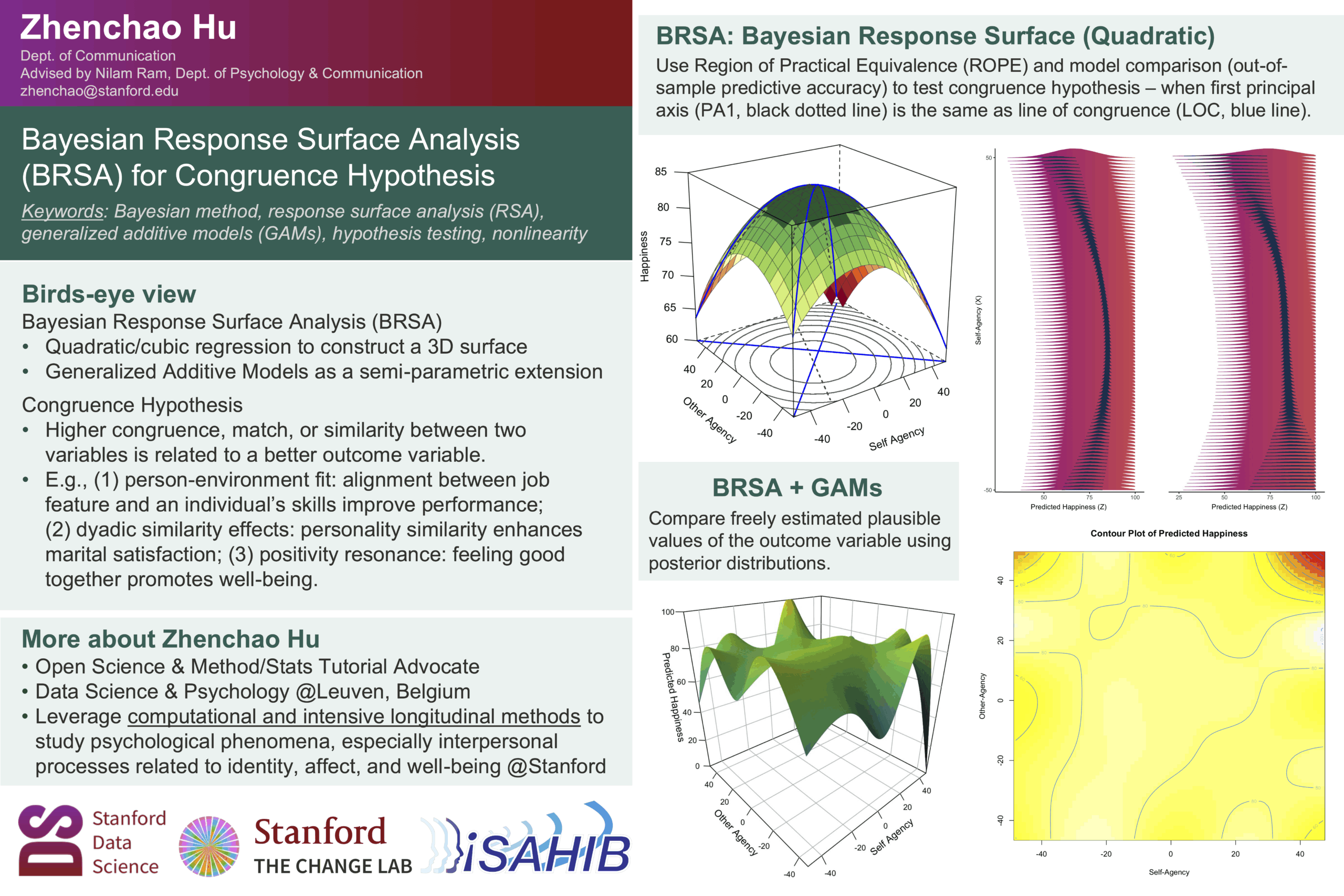
Response surface analysis (RSA) was introduced to test such hypotheses – the congruence (i.e., fit, match, similarity, or agreement) between two predictor variables can produce the optimum condition of an outcome variable. However, the frequentist RSA often stumbles on its essential claim to “accept the null hypothesis.” We propose Bayesian Response Surface Analysis (BRSA) for null hypothesis testing using Region of Practical Equivalence (ROPE) and model comparison (out-of-sample predictive accuracy). Further, we propose the use of generalized additive models (GAMs) in constructing a semi-parametric surface using BRSA and offer explorations of the interpretation of such a surface – what is the best combination of (regions of) the two predictors that produce the optimum outcome of interest?

Conference Poster "Bayesian Response Surface Analysis
(BRSA) for Congruence Hypothesis" by Zhenchao Hu

Citation

5122592 {5122592:ZN6YXNV8} 1 apa 50 default 5005 https://thechangelab.stanford.edu/wp-content/plugins/zotpress/
%7B%22status%22%3A%22success%22%2C%22updateneeded%22%3Afalse%2C%22instance%22%3Afalse%2C%22meta%22%3A%7B%22request_last%22%3A0%2C%22request_next%22%3A0%2C%22used_cache%22%3Atrue%7D%2C%22data%22%3A%5B%7B%22key%22%3A%22ZN6YXNV8%22%2C%22library%22%3A%7B%22id%22%3A5122592%7D%2C%22meta%22%3A%7B%22lastModifiedByUser%22%3A%7B%22id%22%3A12056293%2C%22username%22%3A%22davidbarnstone%22%2C%22name%22%3A%22%22%2C%22links%22%3A%7B%22alternate%22%3A%7B%22href%22%3A%22https%3A%5C%2F%5C%2Fwww.zotero.org%5C%2Fdavidbarnstone%22%2C%22type%22%3A%22text%5C%2Fhtml%22%7D%7D%7D%2C%22creatorSummary%22%3A%22Hu%22%2C%22parsedDate%22%3A%222025-04-29%22%2C%22numChildren%22%3A0%7D%2C%22bib%22%3A%22%26lt%3Bdiv%20class%3D%26quot%3Bcsl-bib-body%26quot%3B%20style%3D%26quot%3Bline-height%3A%202%3B%20padding-left%3A%201em%3B%20text-indent%3A-1em%3B%26quot%3B%26gt%3B%5Cn%20%20%26lt%3Bdiv%20class%3D%26quot%3Bcsl-entry%26quot%3B%26gt%3BHu%2C%20Z.%20%282025%2C%20April%2029%29.%20%26lt%3Bi%26gt%3BBayesian%20Response%20Surface%20Analysis%20%28BRSA%29%20for%20Congruence%20Hypothesis%26lt%3B%5C%2Fi%26gt%3B.%202025%20Stanford%20Data%20Science%20Conference.%20%26lt%3Ba%20class%3D%26%23039%3Bzp-ItemURL%26%23039%3B%20href%3D%26%23039%3Bhttps%3A%5C%2F%5C%2Fthechangelab.stanford.edu%5C%2Fwp-content%5C%2Fuploads%5C%2F2025%5C%2F05%5C%2FHu_Zhencaho_SDS_20250429-scaled.png%26%23039%3B%26gt%3Bhttps%3A%5C%2F%5C%2Fthechangelab.stanford.edu%5C%2Fwp-content%5C%2Fuploads%5C%2F2025%5C%2F05%5C%2FHu_Zhencaho_SDS_20250429-scaled.png%26lt%3B%5C%2Fa%26gt%3B%26lt%3B%5C%2Fdiv%26gt%3B%5Cn%26lt%3B%5C%2Fdiv%26gt%3B%22%2C%22data%22%3A%7B%22itemType%22%3A%22conferencePaper%22%2C%22title%22%3A%22Bayesian%20Response%20Surface%20Analysis%20%28BRSA%29%20for%20Congruence%20Hypothesis%22%2C%22creators%22%3A%5B%7B%22creatorType%22%3A%22author%22%2C%22firstName%22%3A%22Zhenchao%22%2C%22lastName%22%3A%22Hu%22%7D%5D%2C%22abstractNote%22%3A%22%22%2C%22proceedingsTitle%22%3A%22%22%2C%22conferenceName%22%3A%222025%20Stanford%20Data%20Science%20Conference%22%2C%22date%22%3A%22April%2029%2C%202025%22%2C%22eventPlace%22%3A%22%22%2C%22DOI%22%3A%22%22%2C%22ISBN%22%3A%22%22%2C%22citationKey%22%3A%22huBayesianResponseSurface2025a%22%2C%22url%22%3A%22https%3A%5C%2F%5C%2Fthechangelab.stanford.edu%5C%2Fwp-content%5C%2Fuploads%5C%2F2025%5C%2F05%5C%2FHu_Zhencaho_SDS_20250429-scaled.png%22%2C%22ISSN%22%3A%22%22%2C%22language%22%3A%22%22%2C%22collections%22%3A%5B%22BYVDMV9G%22%5D%2C%22dateModified%22%3A%222026-02-16T15%3A54%3A20Z%22%7D%7D%5D%7D
Hu, Z. (2025, April 29). Bayesian Response Surface Analysis (BRSA) for Congruence Hypothesis. 2025 Stanford Data Science Conference. https://thechangelab.stanford.edu/wp-content/uploads/2025/05/Hu_Zhencaho_SDS_20250429-scaled.png

Prior News & Updates