Warning: Undefined variable $post in /home/quantdev/thechangelab.stanford.edu/wp-content/themes/lagunita-theme/Lagunita.php on line 124
Warning: Attempt to read property "ID" on null in /home/quantdev/thechangelab.stanford.edu/wp-content/themes/lagunita-theme/Lagunita.php on line 124
Time-Related Considerations for Modeling Event-Based Data Collected via Ecological Momentary Assessment
- |
- News & Updates
- |
- Publication
- |
- Time-Related Considerations for Modeling Event-Based Data Collected via Ecological Momentary...
Lizbeth Benson, Emily T. Hébert, Nicholas Hartman, Sarah H. Sperry, Walter Dempsey, Darla E. Kendzor, Michael S. Businelle, and Nilam Ràm
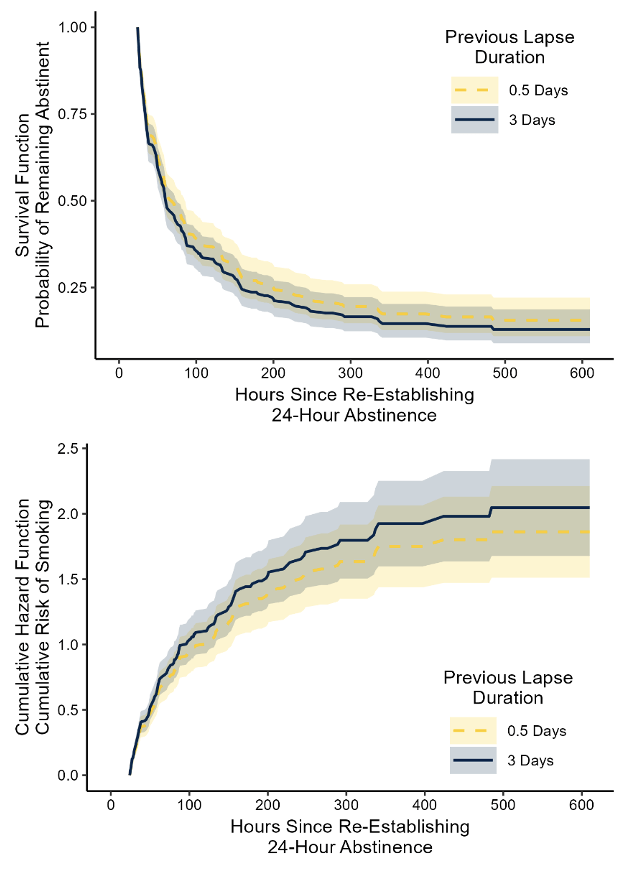
Ecological momentary assessments (EMAs) and wearable devices afford opportunities to collect real-time data on events experienced in daily life. Examples of event-based data in the psychological and behavioral sciences include smoking a cigarette, experiencing a stressor, having a disruption to sleep, experiencing a depressive or manic episode, drinking an alcoholic beverage, or engaging in a bout of exercise. The increasing availability of dense sampling approaches allows for the measurement of such events at relatively fast time-scales (e.g., occurring across minutes, hours, days, or weeks), expanding the possibilities for how time can be conceptualized and modeled. Survival analysis is a modeling approach that allows researchers to address scientific questions regarding whether and when events occur in time. Although not often applied to EMA data, there are myriad research questions relevant to psychosocial and behavioral scientists which can be addressed using survival analysis. This article provides an overview of survival analysis, describes several time-based considerations for modeling event-based EMA data using survival analysis, and provides several illustrative examples of the different time-based considerations. Altogether, the goals of this article are to enhance knowledge of the types of research questions that can be examined using survival analysis, to illustrate nuances of applying the method to EMA data, and to spark ideas for future empirical and methodological research.
![Honors Posters at Symposium of Undergraduate Research and Public Service [April 25, 2026]](https://thechangelab.stanford.edu/wp-content/uploads/2026/04/Garg_SURPSVig_20260425-300x95.png "Honors Posters at Symposium of Undergraduate Research and Public Service [April 25, 2026]")